
Identifying Evergreens: 7 Types Every Indiana Yard Might Have
Identifying evergreens can feel surprisingly tricky, even for homeowners who’ve had the same trees in their yard for years. Many people use “evergreen” and “pine tree” interchangeably, but that’s really just one branch of a much bigger family that includes spruces, firs, hemlocks, cedars, and a few surprising exceptions. If you’re planning new landscaping or just curious what’s already growing on your property, here’s a straightforward guide to identifying evergreens common to Indiana.
Why identifying evergreens matters for your landscape
Evergreens do something no other plant in your yard can: they hold onto their color through the winter months, when everything else has gone bare. Beyond the visual benefit, they also offer real thermal protection for birds and wildlife during cold weather, making them a functional as well as a decorative part of a landscape. Knowing which type you have, or which type might suit a new planting, starts with identifying evergreens by their needles and cones.

Pines: needles in bundles
Pines are one of the easier evergreens to identify once you know the trick, their needles grow in small bundles, called fascicles, of two, three, or five needles, and their cones hang downward from the branch.
Two-needled pines are the most common group you’ll encounter in Indiana, including Jack pine, Virginia pine, Scots pine, Austrian pine, and Red pine, ranging from shorter to longer needles. Three-needled pines are rarer here, though Loblolly pine is one example, recognizable by needles that stretch six to nine inches long. For a five-needled pine, Eastern white pine is the one you’re most likely to see in Indiana landscapes.
Spruces: square needles, one at a time
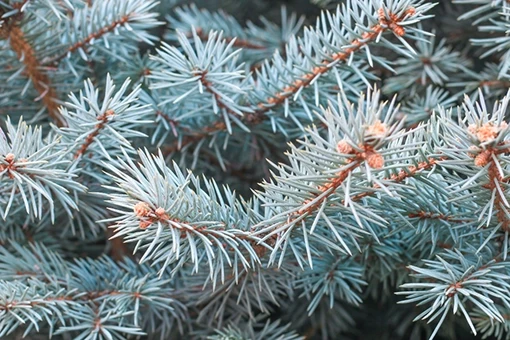
Spruces are distinguishable from pines by their needles, which are square in cross-section and attach individually to short pegs on the stem rather than growing in bundles. Like pines, spruce cones hang downward from the branches.
There are no spruces native to Indiana, but you’ll commonly see Black spruce, White spruce, Norway spruce, and Colorado blue spruce planted in area landscapes, again ranging from shorter to longer needles. Norway spruce has a distinctive look even from a distance, its branchlets droop noticeably from the main branches, giving the whole tree a slightly weeping appearance.
Firs: soft, flat needles that point up
Firs have soft, flexible, flattened needles attached singly to the stem, similar to spruce in that they don’t grow in bundles. The easiest way to tell firs apart from spruces and pines is the cones, fir cones grow upright on the branch rather than hanging down.
Balsam fir and White fir, also called Concolor fir, are two you may encounter in Indiana landscapes. One tree that’s commonly mistaken for a fir is Douglas-fir, but it’s technically not a true fir; its cones hang down like a pine or spruce and have distinctive three-pointed bracts poking out from the cone scales.
Eastern hemlock: a shade-tolerant exception
Eastern hemlock stands out among evergreens for its flat needles that appear green on top and whitish underneath. It’s also unusual in that it tolerates shade far better than most other evergreens, which typically need full sun to thrive.
Cedars: scale-like or awl-like needles
Rather than needles in the traditional sense, cedars have foliage that’s either awl-like, short and pointy, or scale-like, resembling overlapping fish scales. Eastern redcedar and Northern white-cedar, also known as Arborvitae, both fall into this category.
Eastern redcedar is by far the most widely distributed native conifer in Indiana, easily identified by its small, pale-blue, round cones. Northern white-cedar performs well in many Indiana landscapes too, and columnar varieties are frequently planted as a living privacy fence.


Evergreen exceptions: conifers that aren’t evergreen
Most evergreens are conifers, meaning they produce cones, and most conifers stay green year-round. But there are a few notable exceptions to keep in mind when identifying evergreens: Baldcypress, Dawn redwood, and American larch, also called Tamarack, are all conifers that actually lose their needles each fall, behaving more like deciduous trees.
Baldcypress and Dawn redwood share soft, flat needles, while Tamarack is a bit different, showing clusters of many needles on older growth but single needles on newer growth.
Which evergreens are native to Indiana?
It might come as a surprise that Indiana’s list of native conifers is fairly short. It includes Eastern redcedar, Jack pine, Eastern white pine, Virginia pine, Northern white-cedar, Eastern hemlock, Tamarack, and Baldcypress. With the exception of Eastern redcedar, most of these are only native to limited areas within the state.
That doesn’t mean non-native species should be ruled out. Many are well-suited to Indiana’s climate and can thrive here for decades, while others may struggle with longevity depending on site conditions. If you’re unsure which species fits your property best, that’s a conversation worth having before planting.
Let us help with identifying evergreens on your property
Whether you’re trying to identify a tree that’s already established in your yard or deciding what to plant next, our team can help you sort through the options and pick species suited to your specific landscape. Contact Wells Lawn Care & Landscaping to talk through what would work best on your property.
For additional visual references, the Arbor Day Foundation’s tree identification guide is a helpful resource with photos to cross-check what you’re seeing in your own yard.